Why Satellites Deserve Our Attention
- VarvaraKutyina

- 17 nov. 2025
- 8 min de lecture
Dernière mise à jour : 17 nov. 2025
Satellites have become an integral part of the world’s infrastructure, quietly enabling countless aspects of modern life. From global communications and navigation to weather forecasting and scientific discovery, the average person benefits daily from satellite technology.

In essence, a satellite is any object that orbits a larger body in space. Natural satellites include celestial bodies like the Moon orbiting Earth, or even small galaxies orbiting larger ones, while artificial satellites are human-made machines launched into orbit for specific purposes. Since the idea of using satellites for worldwide radio coverage was first proposed by Arthur C. Clarke in 1945, humanity’s interest in satellites has only grown.
The launch of Sputnik 1 in 1957 marked the dawn of the Space Age, and today thousands of satellites orbit Earth, delivering services that touch virtually everyone’s lives. This article provides an overview of what satellites are, how they work, why they are so important, and how the rapidly growing number of satellites is shaping new challenges for the future.
What are Satellites?
In contrast, to natural satellites or cosmic objects, artificial satellites are man-made objects intentionally placed into orbit around Earth or another celestial body. These range from small CubeSats weighing only a few kilograms to massive space stations or communication satellites weighing several tonnes. They can be deployed in various orbital regimes, from low Earth orbits (LEO) a few hundred kilometers above the ground to geostationary orbits (GEO) about 36 000 km up. The choice of orbit depends on the satellite’s mission. Lower orbits are often used for high-resolution Earth observation or low-latency communications, whereas higher orbits like GEO allows satellites to hover over one spot on Earth’s equator, useful fro constant coverage.
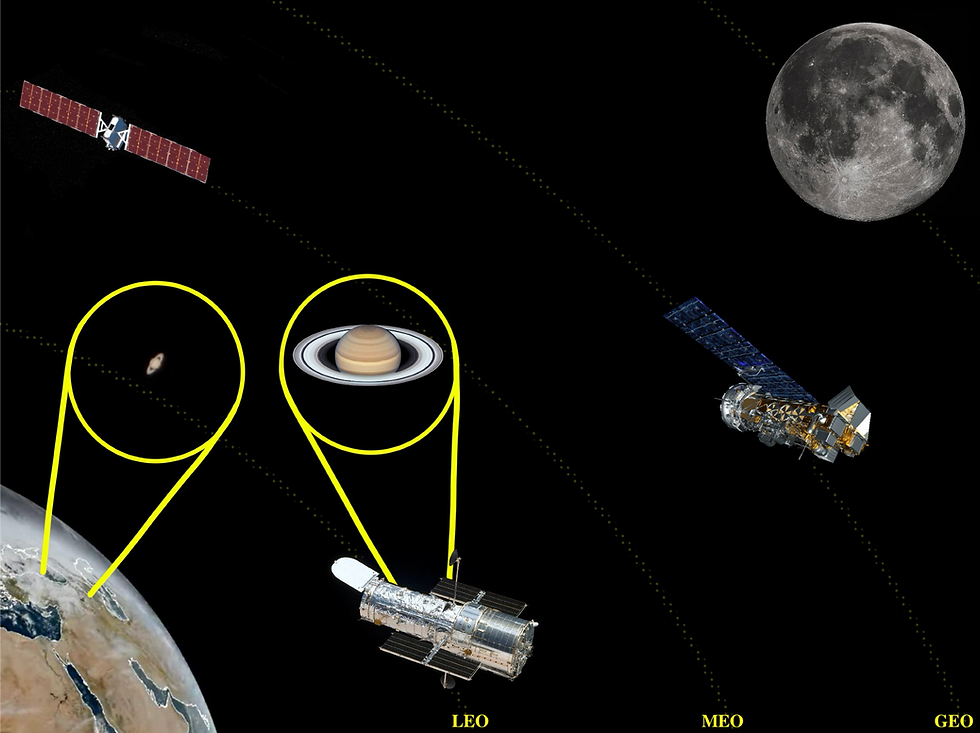
Satellites also offer us eyes and ears beyond Earth’s surface. The atmosphere blocks or distorts many types of radiation from space and prevents high-energy particles like cosmic rays from reaching the ground. Ground-based telescopes are blind to these forms of light. By placing specialized telescopes on satellites above the atmosphere, scientists can collect accurate data across the entire electromagnetic spectrum. In this way, artificial satellites have opened new windows to the universe.
How do satellites work?
Orbits and satellites lifetimes
To stay in orbit, a satellite must be launched to very high speeds so that it continuously “falls” around Earth without crashing into it. A satellite’s orbit, including its altitude, inclination, and shape, is selected based on its mission and coverage needs. Countries or companies planning new satellites carefully match mission requirements with appropriate orbits and expected lifetimes.
Some orbital regions are more crowded than others. LEO (altitudes below ~2 000 km) has become the busiest highway in space. As of 2024, over 90% of all active satellites were in LEO. This is largely because low orbits allow fast two-way communications (low latency) and require less energy to reach, making them ideal for the new wave of large satellite fleets providing global internet and Earth observation services. LEO congestion is a growing concern. Unlike higher orbits where satellites can remain aloft for decades, objects in LEO experience atmospheric drag, causing them to slowly spiral down over time.
Satellites in LEO must periodically fire onboard thrusters to maintain orbit. When they run out of fuel or suffer system failures, they become space debris until they finally re-enter the atmosphere and burn up. This fast turnover (typically 5 to 15 years) requires constant replenishment, pushing technological evolution but also contributing to the growing cloud of orbital debris.
Communication and Telemetry
Satellites communicate with ground stations by using radio waves to send and receive signals. Each satellite carries one or more antennas to transmit data to Earth and receive commands from Earth. On the ground, large parabolic dish antennas track satellites and pick up their faint signals. These dish antennas, some as large as 70 meters in diameter, focus incoming radio waves to a feed horn or sub-reflector at the dish’s focal point.

Telemetry, scientific data, and other communications are modulated onto these radio signals. When received by ground stations, the signals are amplified, digitized, and processed into useful information such as images, measurements, or message data. Ground stations also transmit commands and data back to satellites using powerful transmitters and antennas.
Because different missions operate on different radio frequencies, space agencies, countries, and private owners employ various types of antenna designs. One example is the High Efficiency (HEF) antenna, which has a feed that works well for specific frequency bands but is physically difficult to upgrade or access. Newer designs like the Beam Waveguide (BWG) antenna use a series of mirrors to redirect signals through an internal tube down to a protected room at the base of the antenna, making maintenance easier and supporting multiple frequencies with interchangeable equipment. Despite differences in design, the fundamental operation is the same: capturing electromagnetic waves and converting them to data.
It’s not just single giant antennas doing the work. Antenna arrays can combine the signals from multiple smaller dishes to simulate a much larger receiver, offering cost-effective scalability. For instance, multiple 12 meter antennas can equal the performance of a single 70 meter dish. These modular arrays are easier to maintain and are expected to play a greater role in the future.
The Value of Satellites
We take interest in satellites not only for their engineering marvels but for the vital services they provide. It’s often said that satellites make the global village possible. They connect people, enable informed decisions, and even save lives. Satellites play a central role in communication and navigation, supporting long-distance broadcasting, global internet, and real-time positioning systems like GPS.
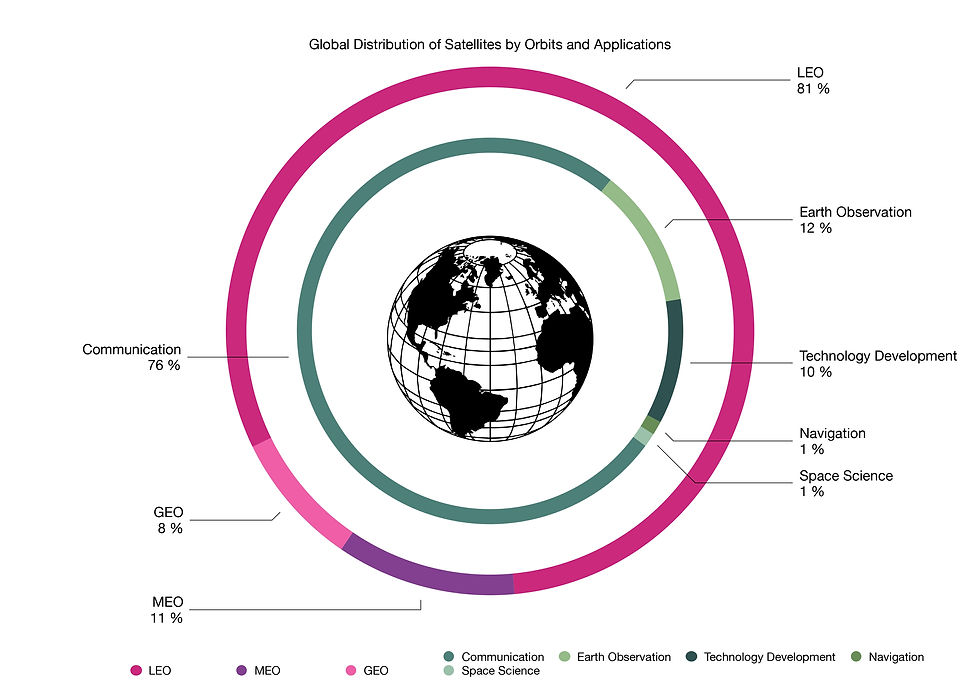
Satellites also support Earth observation and weather forecasting by tracking storms, monitoring agricultural productivity, and mapping environmental changes such as deforestation or urban growth. This data aids farmers, disaster response teams, and climate scientists alike. In science, satellites act as laboratories in space, measuring Earth’s magnetic fields, solar activity, and cosmic radiation, and enabling discoveries far beyond the reach of ground-based instruments. Finally, a significant number of satellites serve defense and intelligence purposes, providing high-resolution imagery, secure communication links, and early warning systems. Their ability to observe from orbit offers strategic advantages in both national security and global peacekeeping.
Beyond these categories, satellites have numerous other applications, supporting search-and- rescue beacon systems, mapping Earth’s gravity and geology, enabling financial transactions (through precise time stamps), and even entertainment (satellite radio and TV). It is no exaggeration that everyone benefits from satellites: the farmer checking weather forecasts, the student using GPS on a field trip, the family watching live sports via satellite TV, or the scientist studying climate patterns. Our interconnected, information-rich society is built on space infrastructure as much as on terrestrial infrastructure.
The Rapid Growth of Satellites and Its Challenges
Space is no longer the vast, empty void we once imagined, Earth’s orbital neighborhood is increasingly crowded with human-made objects. The number of active satellites has skyrocketed in recent years. A decade ago there were only about 1 500 operational satellites, but by 2024, that number had surpassed 8 000, driven by mega-constellations like SpaceX’s Starlink and OneWeb. These fleets promise global connectivity but raise concerns about orbital congestion and interference. Astronomers now frequently encounter bright streaks in telescope images from satellite reflections.
This rapid growth is not limited to private companies. National projects are also ramping up the satellite count. China has announced its Guowang mega-constellation, planning to launch 13 000 satellites to expand global internet coverage. The European Union is developing IRIS² with 170 satellites for secure communications. As competition increases, international cooperation becomes critical. Orbital slots and radio frequencies are limited resources. Without shared standards for satellite deployment and operation, the risk of interference or conflict increases.
But the rapid expansion of satellite networks doesn’t just clutter the skies. It also leaves a mark on the ground. With every new constellation or upgraded system, ground-based antennas and support equipment proliferate, and many old units become obsolete. Over decades, this has created a quiet but growing pollution problem on Earth, a landscape dotted with abandoned satellite dishes, defunct ground stations, and heaps of electronic waste.
Obsolete antennas littering the earth
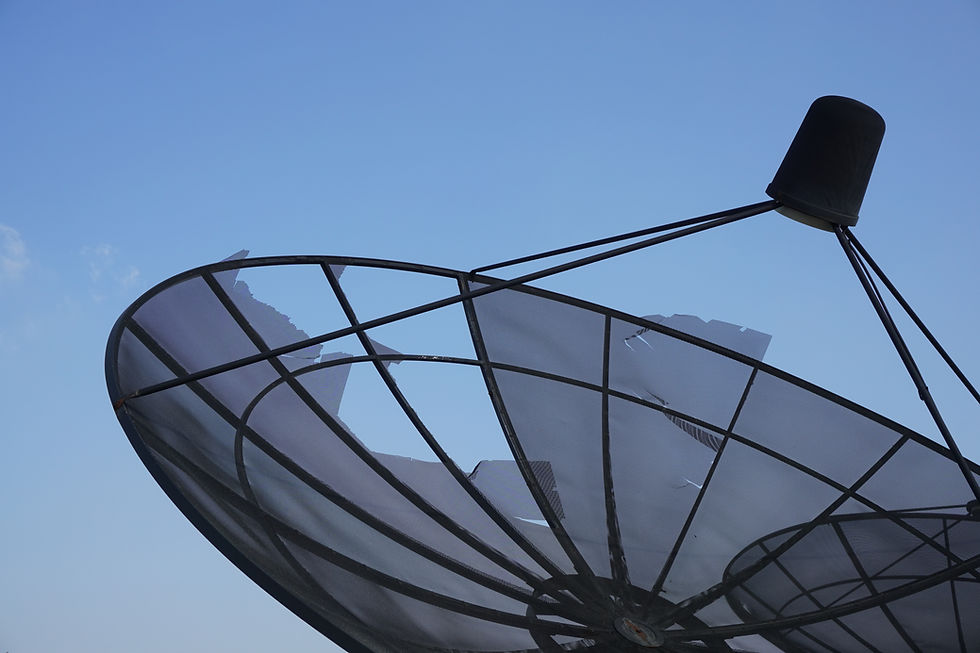
In the early days of satellite communications, huge parabolic dishes, some 20 to 30 meters across, were installed around the world to track satellites and beam signals across continents. Many of those first-generation Earth stations have since been decommissioned as technology advanced. For example, the Congor Bay Satellite Earth Station in Barbados was shut down after only 24 years of service and its 30 meters is left to rust in place as a relic of the past.
Similar stories abound, iconic ground stations like Jamesburg (USA) or Raisting (Germany) have been retired, with some facilities repurposed or scrapped and others simply abandoned. Each such site represents tons of material, steel, aluminum, and electronics, that need either removal or re-purposing. Unfortunately, until recently there have been few incentives or programs to deal with these behemoths once their operational life ends.
From Backyard Dishes to Mega Constellation Terminals
It’s not just the giant antennas at official stations, millions of small satellite dishes have been installed on rooftops and backyards, and these too contribute to the ground pollution problem. In the 1980s and 90s, the rise of satellite TV saw over one million homes sporting C-band dishes at the peak. When direct-to-home systems moved to smaller Ku-band dishes and cable/fiber spread, those analog giants became obsolete virtually overnight. Many ended up in scrapyards or left to decay behind houses and barns. Today, history is repeating on a larger scale with satellite internet equipment. Mega-constellations like SpaceX’s Starlink are deploying not only thousands of satellites in orbit, but also millions of user antennas on the ground.
Each Starlink subscriber needs a pizza-box-sized phased array dish. And today, they have roughly four million customers and therefore terminals that will inevitability join the piles of “space-age” electronic waste. Already, community recycling centers warn that satellite dishes contain circuitry and metals that classify them as e-waste, not regular trash. Improper disposal can leach toxic materials like lead or arsenic into soil and water. The sheer scale of the issue is notable. Globally, around 50 million tons of electronic waste are generated each year, and obsolete satellite equipment increasingly adds to this heap.
A sustainable future for both sky and earth
Satellites captivate us not only for what they are, complex machines orbiting high above, but for what they enable here on Earth. For the general public, they s mean instant communication, precise navigation, accurate weather forecasts, and awe-inspiring images from space. For professionals in this field, they represent innovation and where sky is not even the limit.
But growing interest also brings growing responsibility, both above the atmosphere and here on Earth. Ensuring a sustainable future means addressing the environmental impact of satellite infrastructure at every stage. Projects like UpSat Cycle signal an important shift: recognizing that space sustainability begins on the ground. By investing in the cleanup and upcycling of obsolete antennas now, we can preserve the environment, recover valuable materials, and set a precedent of responsibility. Just as we are inspired by what satellites can do for humanity, we must remain aware of the footprint they leave behind, from launchpad to orbit to scrapyard. If the space sector can confront these challenges head-on, it can truly close the loop in its supply chain and make its operations sustainable from ground to sky.
Bibliography :
Citizen Communications, LLC. (2025). Satellite dishes – Oceanside Recycling Guide. Recyclist (Green Oceanside). https://greenoceanside.recyclist.co/guide/satellite-dishes/
Krishnamurthi, M. (1989). Satellites [PDF]. Defence Scientific Information and Documentation Centre. https://www.drdo.gov.in/drdo/sites/default/files/publcations-document/SATELLITES.pdf
Long, R. D. C. (2021). Congor Bay Satellite Earth Station revisited. PK Porthcurno. https://pkporthcurno.com/pk-stories/congor-bay-revisited/
National Aeronautics and Space Administration. (2023, October 16). What is a satellite? In Space Communications and Navigation Fun Facts. NASA. https://www.nasa.gov/directorates/space-operations/space-communications-and-navigation‑scan-program/scan-outreach/fun-facts/
Tran, B. (2025, July 8). Satellite mega-constellations: How crowded is Earth’s orbit? (New deployment stats). PatentPC. Retrieved from https://patentpc.com/blog/satellite-mega-constellations-how-crowded-is-earths-orbit-new-deployment-stats
Commentaires